See how Retool secures your vibe-coded apps: AI made building easy. Retool makes it safe—one governed platform for every app your team builds, no matter where it started.
Every company is feeling the pressure to “do something with AI.” The biggest decision most teams face isn’t whether to use AI, though—it’s how they use it, and how much control they want over its implementation.
On one end of the AI tooling spectrum, you have ready-made SaaS products with AI agents built in and ready for use—like customer support chatbots, sales assistants, or AI-driven analytics dashboards. At the other end, there are custom agents built around LLMs and agentic workflows capable of autonomous decision making, API integration, and real-time action. And of course, an array of hybrid approaches in between.
There’s a lot to consider when it comes to building AI tools, too. Data readiness, security, and guardrails are all important to think about when considering building your own AI-powered solution. But the payoff of building your own bespoke AI agent could mean a solution as unique as your problem.
In this guide, we’ll look at the pros and cons of both building and buying agents, and review key criteria to consider as you decide.
Pros and cons of buying AI agents
Buying a ready-made agent has its appeal. If your customer support team is drowning in tickets and needs help urgently, an AI agent like Zendesk’s can rescue your team much faster than a custom solution can.
With teams facing mounting pressure to adopt and automate with AI, solving a problem now might win out against solving it precisely. Here are some upsides of buying AI agents:
Pros of buying
Organizations today face a new reality: tight deadlines, limited resources, and pressure to adopt AI capabilities that deliver real ROI. For many organizations, buying existing AI solutions offers the fastest path to production-ready results.
When you buy, you get proven technology without the months of experimentation, hiring specialized talent, or debugging models that seemed promising in demos but struggle with real-world data.
Near-immediate deployment
Instead of months spent scoping, finding (and hiring) the right engineers to work on your project, building, and testing, you could have a solution up and running in a matter of days.
Lower upfront costs
Vendors promise predictable pricing that’s a lot easier to wrap your head around. Pre-built agents let you validate whether AI actually solves your problem before you’ve sunk significant costs and development resources into a custom build. You’ll pay for the agent and the API calls, but you won’t need to spend time and money maintaining the operational scaffolding around your agent.
Proven performance track records
When you use AI agents built on top of an existing platform, the vendor takes responsibility for performance, maintenance, and security. Existing MLOps platforms (such as IBM Watson Studio, Databricks), conversational AI (Zendesk, Intercom), and data science platforms (MATLAB, RStudio) are all established in their niches, and come with active user communities for support.
User-friendly options
You need AI and an intuitive interface to make the most of its capabilities, especially as more non-technical teams take on building roles.
Cons of buying
The decision to buy isn’t always this simple, though. There are both business and technological constraints that might tip the scales towards building instead. For many organizations, buying AI agents offers clear practical advantages over building from scratch—but, it can come at a cost.
Limited customization
Ready-made agents, even the ones designed for specific use cases, deliver generic solutions that rarely match your unique processes, and you’ll hit utility limits without customization options as needs evolve. When your competitors have access to the same customer service or outbound SDR agents, there’s no scope for differentiation. Expect to spend time tuning the prebuilt solution to your requirements—whether that’s business logic, custom integrations, or the desired user experience.
Less control over agent autonomy
Andrej Karpathy refers to the “autonomy slider (opens in a new tab)”—the mechanism you have over how much agency your AI solution has. Buying an agent instead of building it yourself means you might be stuck with a default level of autonomy you’re not comfortable with.
Ecosystem lock-in
When you buy an AI agent, you’re also buying into that vendor’s ecosystem and all its proprietary constraints. Switching to a different provider to gain other functionality can come with unexpected toil, like rewriting code, retraining a new model, and reworking data.
AI market volatility
The AI market is growing, but it’s constantly changing. As with any new technology, whatever solution you choose isn’t guaranteed to go the distance. You could be left with nothing to show for your time and effort if a vendor closes, gets acquired, or becomes subject to regulatory changes.
Data privacy concerns
If your agent needs to work with proprietary information or sensitive customer data, you might not want to share these with a third party. Compliance concerns, security, data ownership and deletion or retention are all factors to be aware of.
Unpredictable agent pricing models
With new technology comes evolving strategies and standards for AI agent pricing. Performance and outcome-based pricing models are emerging alongside the annual subscriptions. Not to mention the hidden costs that can show up as your team, dataset, or usage grows.
Why build AI agents?
Building custom agents isn’t just for tech giants with massive engineering teams. Agile teams of developers and non-technical process owners have more tools than ever at their disposal to create bespoke agents for their core business problems—problems that they’re closest to.
Here’s when building becomes your strategic advantage:
Unique competitive advantage
Long term, the ability to build and deploy custom agents to automate work will likely become table stakes. Establish that ability in your organization now and benefit from agents that scale with your business. AI-native development
By owning the building process yourself, you can design your AI solution from the ground up instead of relying on shoehorned AI capabilities.
Complete control

Building your own agent means your data, algorithms, and business logic stay internal, simplifying compliance requirements.
Technical flexibility
You can use standard languages, frameworks, and open source tooling to meet your needs, rather than being hamstrung by proprietary systems’ limitations.
When not to build your own agents
Even though it’s getting easier, building your own agent still involves some technical complexity, resource commitment, and ongoing maintenance.
Higher infrastructure and time costs
You probably won’t train GPT-5 from scratch, but building a custom agent still hits your budget harder than expected. Take a support agent that knows your company policies—you’ll need compute to process your docs and tickets into training data, plus storage for vector databases and ongoing API costs. Factor in the engineering time to build pipelines that don’t break when someone uploads a weird CSV, and that “simple” agent becomes a real budget line item.
Hiring requirements and costs
Even with the rise of vibe coding, building and deploying agents for business-critical infrastructure can require specialized engineers. Your existing eng team could handle some of the work (potentially at the expense of other projects), but since AI engineering disciplines are new and evolving, you may not have the right expertise in-house. Machine learning engineers can command $169k+ (opens in a new tab), while senior AI roles may require investment of over $200k (opens in a new tab).
Longer development timelines
Getting an AI agent into production is a significant engineering lift. Agent development platforms make building basic prototypes faster, but production-ready systems that handle your business logic, integrate with existing infrastructure, and meet security standards still demand serious engineering work. Depending on the complexity of the project, it can run to months versus the weeks you’d likely need to stand up an agent you bought.
Technical and resource requirements
Is your data in a state that an LLM can access and parse? Do you have sufficient compute resources? Are you ready for AI-native development approaches? Let’s explore these in more depth.
Technical and resource requirements for building AI agents
While it seems like every company is building and launching its own coding agent (opens in a new tab), building an agent that’s unique to your needs and differentiated enough to warrant the effort comes with a lot of overhead. You’ll need:
AI-ready data
Your agent will only be as effective as the data it can access. You need a clean, accurate dataset that’s structured and labeled in a way that the system can parse, which might be different to the requirements for your tools that monitor and report on your data now. Duplicates, inconsistencies, and inaccuracies in your data can undermine all your efforts.
Depending on your agent use case, you may need to create, collect, or acquire a whole new dataset for training purposes. Automating customer support might require you to collate processes and policies that are scattered across sources of truth (if they’ve been documented at all).
Technical infrastructure
Building a custom agent means setting up infrastructure that goes way beyond just the AI model. You’ll need compute for processing your docs into embeddings and fine-tuning on your data, and those costs add up as you iterate. There’s also storage infrastructure to consider: vector databases, conversation logs, model versions, backups, all while keeping response times snappy under real user load.
Building an agent gives you better control over security, but you’re responsible for implementing access control, data encryption, and compliance requirements. Even adding Google SSO (opens in a new tab) involves more clicking than you’d expect. You’ll also need monitoring dashboards, error handling, rate limiting, and data pipelines that don’t break.
Development approaches
Whether you choose a code-first or visual programming approach to building your agent (or a bit of both), there are tradeoffs.
Coding from scratch offers full control over your model architecture, data preprocessing, and infrastructure, which is great for fine-grained customization but takes longer and requires in-house AI and machine learning expertise. Non-technical stakeholders may find it harder to contribute to the process.
Using a low-code tool with a visual, drag-and-drop interface for development is more accessible (and quicker), but might limit customization and be harder to debug with so much abstracted away. Using a proprietary tool for visual programming also comes with the risk of vendor lock-in.
Building on a platform or app layer offers (we think) the best of both approaches—especially if your platform lets you write as much code as you want when you hit the ceiling of its prebuilt components.
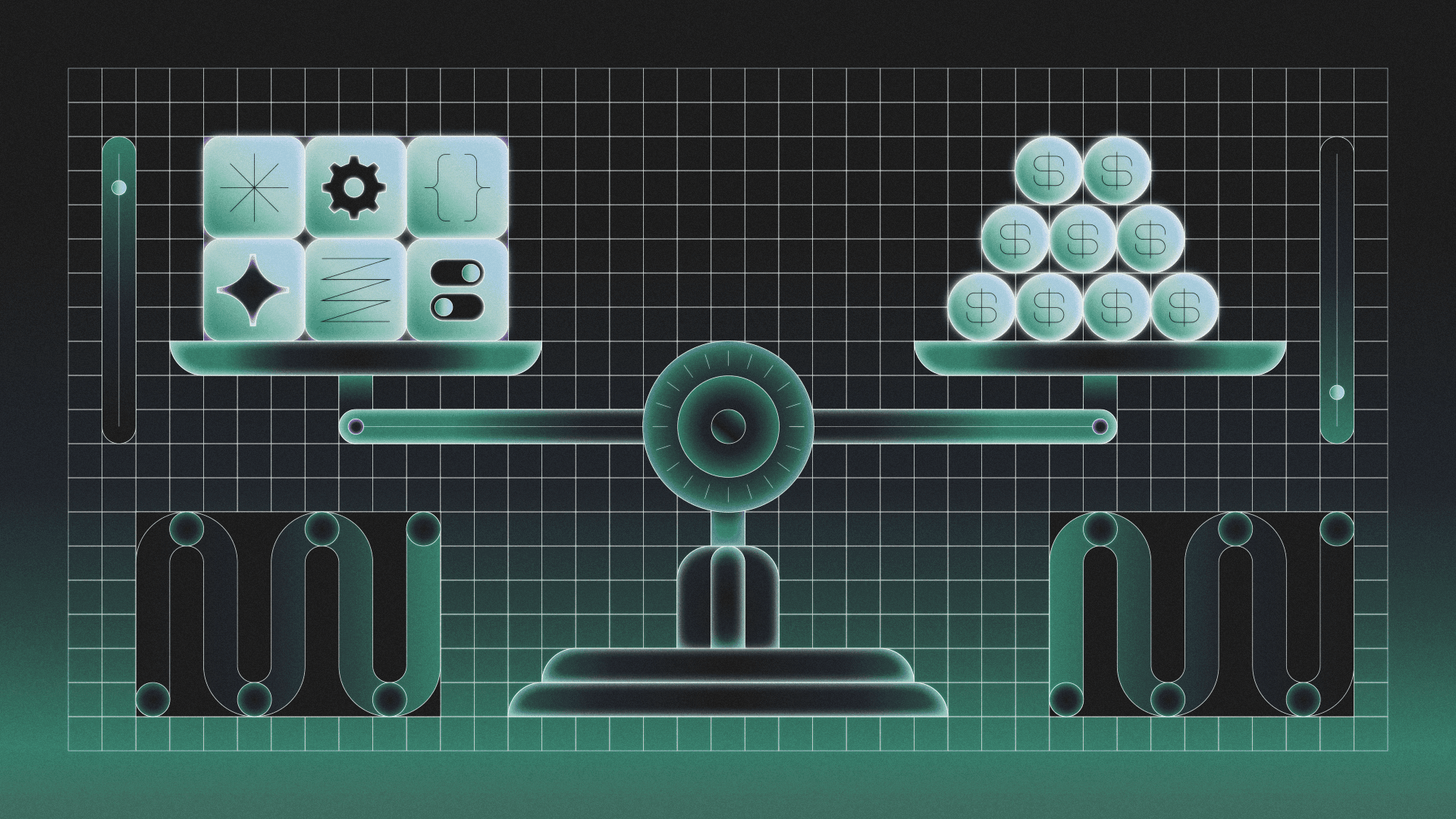
Cost-benefit analysis: building vs. buying
To bring all of the above considerations together:
What’s the ROI of building an agent in-house vs. buying?
If the the agent in question will automate or significantly reduce manual work hours in business’s core processes, the competitive advantage of building the agent yourself may outweigh the complexity and costs of being responsible for the complex infrastructure requirements.
Still, you should be realistic about whether the agent will truly help you differentiate. . Intercom describes it as “Invest in what makes you unique.” (opens in a new tab) If you’re not going to build the best-in-class version of the agent (and commit to keeping up with fast-moving developments in AI), is this a good investment of your budget and your team’s time?
Financial considerations for custom agents
While there’s no universal formula for estimating the cost of building an agent, there are inputs and estimates that you can start with.
- Implementation costs: While estimating build costs is always going to be a bit of “back of the napkin” math, you should factor in technical and personnel requirements as well as hardware costs.
- Platform economics: Buying an agent can feel like more of a known known, since the price is calculated for you, but AI pricing can be unintuitive, and you are at the mercy of any vendor price increases or tier changes. While steep upfront, building yourself can offer more predictable, transparent costs in the long term.
- Total cost of ownership: If you’re building something to use long term, you’ll need to maintain it as well. Long-term maintenance is typically where internal tools fall down too, so plan for costs over the next 3-5 years.
- Cost of outages: If your agent is customer-facing, can you estimate the cost of an outage or service degradation?
- Risk assessment: Depending on a vendor comes with its own risks, including outages over which you have no control. It’s worth exploring what your migration options are if the business closes down or is acquired.
- ROI timeline: What impact can you expect in the short term, vs how long do you expect to wait for critical differentiation?
Could you solve this business problem without an agent?
“Nothing works automagically. You still have to build in all the operational characteristics that you would for any traditional system. It’s deceptively easy to look at some AI agent demos and think ‘oh, I can replace my team’s huge mess of spaghetti code with a few clever AI prompts!’ And it may even work for the first couple use cases. But all that code is there for a reason, and eventually it’ll have to be reckoned with.” —daxfohl on Hacker News (opens in a new tab)
We’d be remiss if we didn’t ask: what if the question isn’t build or buy, but do you really need an agent to solve your problem? The wave of new AI solutions on the market—whether dedicated or built into your existing toolchain—has created an environment where everything looks like a nail (opens in a new tab).
Before going all in on building a custom agent, it’s worth considering if you could use your existing toolset instead. A lot of business processes are formulaic and solvable with automation rather than more complex and expensive genAI agents. You can even implement agentic workflows as an efficient middle ground for workflows with repeatable processes, and are a lighter lift than implementing genAI agents.
Final recommendations
Custom agents that drive competitive advantage will serve you now and help build your organization’s AI development muscle for the future. Whether you choose to build or buy agents (or some combination of both) will come down to what you’re building and what you’re optimizing for: speed or customization.
- Ready-made agents: The fastest, lowest-cost way from zero to one for straightforward use cases where you don’t have bespoke requirements. Off-the-shelf AI tools are limited in opportunities for customization though, and may require some time spent on integrations.
- Custom agents: For a higher upfront investment, building a custom AI application lets you create a unique, differentiated offering with sustained competitive advantages, but may take longer to go from prototype to production.
- Hybrid approaches: Building your own agent with a platform offers a way to balance speed with customization by letting you combine pre-built components with your own code.
Why use Retool
With Retool’s Agents, you can build AI agents without the high barrier to entry. The agents you build can:
- Connect to any system
- Use any LLM
- Maintain full visibility
- Stay secure with enterprise-grade controls
Special thanks to Rebecca Dodd for her contributions to this piece.